

Seven C's of Luxury


When I first got into climate advocacy, there was a real stereotype. Sustainable people were crunchy hippies who thought shaving was optional and Tevas with socks were an acceptable thing to wear. That stereotype still lingers in some corners of the internet, but walk into Chloé's Paris headquarters, which became a B-corp in 2023, or scroll Stella McCartney's mushroom leather line, and you'll find a very different picture. Gucci has committed billions of dollars to its Circular Hub, developing lab-grown diamonds and 100% recycled gold. Sustainability has gone from crunchy to couture.
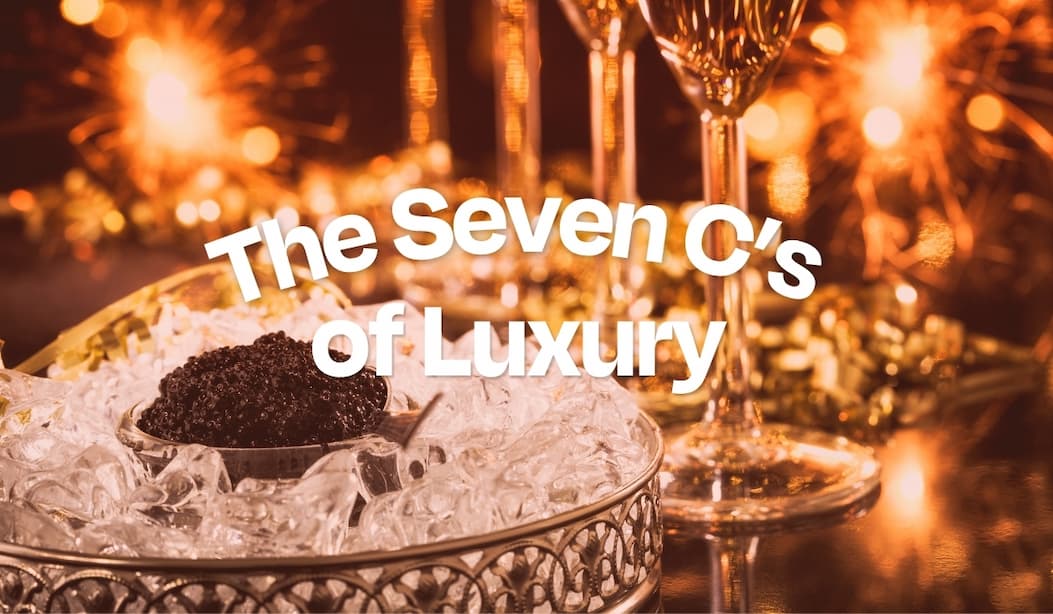
So, let's stay on this luxury train and talk about the Seven C's, which I thought was an established thing until I tried to research this piece and came up empty handed. Turns out, maybe someone I know made it up? Either way, the Seven C's of Luxury according to someone I don't remember are champagne, cheese, chocolate, cigars, cognac, coffee, and caviar. Let's dig into the sustainability of them.
Champagne:
The bubbles come with a slight sustainability risk, mostly from climate change because rising temperatures and extreme heatwaves have forced earlier harvests. Some major houses have even bought vineyards in Kent, England, where the cooler temperatures and chalk soil now resemble what Champagne looked like decades ago, though thanks to the region's protected designation of origin, anything grown outside Champagne can't legally carry the name. Beyond the changing climate, some vineyards still rely on synthetic herbicides and fungicides to protect high-yield crops.
The overall industry, which produces upwards of 300 million bottles a year across roughly 16,000 growers and 300-plus houses, is making impressive strides. The Champagne Committee was the first wine region to measure its carbon footprint in 2003, and Champagne Telmont became the first Regenerative Organic Certified sparkling wine producer in early 2026, building on years of work toward its goal of being climate positive by 2030 (60 percent of its estate and grower partners are already certified organic or converting). Bollinger ended herbicide use back in 2016, was the first French wine house certified HVE, and is now targeting 100% recycled packaging along with lighter glass bottles to cut shipping emissions. Moët & Chandon has used sustainable viticulture since 2001 and even grazes sheep through its vineyards to cut down on herbicide use, while Pommery has turned to solar power and beehives to support biodiversity. Taittinger, meanwhile, picked up both VDC and HVE accreditation back in 2017 and has been recognized for its responsible water and fertilizer management and its focus on protecting biodiversity across its terroir.
Look for the HVE (Haute Valeur Environnementale) or VDC (Viticulture Durable en Champagne) labels, both of which Taittinger carries, the AB mark for organic farming, Terra Vitis certification, or a B Corp badge like Charles Heidsieck carries. Organic is still a small slice of the region (production has grown from 1% of vineyards in 2009 to nearly 10% today), so if you find it, it's genuinely a find.
Cheese:
Dairy is thirsty, and producing one kilogram of cheese can take roughly 5,000 liters of water, with milk production alone responsible for more than 85% of cheese's total environmental footprint. Put another way, a kilogram of cheddar carries a carbon footprint of around 8.6 kg of CO2 equivalent, on par with some cuts of beef. The clearest signal to look for is grass-fed or organic certification, plus Animal Welfare Approved or Certified Humane labels for how the animals are raised. Buying local also matters here more than in most categories since it cuts transport emissions and supports smaller producers who tend to be more transparent about their practices. Goat and sheep cheeses are worth a look too, generally lower impact than cow's milk.
Chocolate:
This is the category with the most at stake. More than 60% of the world's cocoa comes from West Africa, where cocoa farmers receive a mere 6% of what a chocolate bar sells for in the supermarket, a gap that drives both poverty and deforestation. Rainforest Alliance certification now requires GPS mapping of every certified farm, cross-referenced against deforestation risk maps, and Fairtrade guarantees a price floor plus a community premium. Look for either seal, and note that Lindt & Sprüngli recently moved to sourcing 100% Rainforest Alliance Certified cocoa, so this is becoming easier to find even in mainstream bars.
Cigars:
The least regulated of the seven. Tobacco farming accounts for about 5% of global deforestation, largely because wood-fired curing barns rely on timber cut from forest reserves. There's no major consumer-facing eco-label yet, but a wave of smaller producers is shifting the norm: organic growing methods in places like Nicaragua now eliminate 60 to 80% of pesticide use, and some makers have moved to FSC-certified cedar boxes. Your best bet here is a brand that's transparent about where and how the tobacco was grown, since there's no seal to shortcut the research yet.
Cognac:
Cognac runs its own version of the HVE playbook. The region's Certification Environnementale Cognac evaluates five pillars: biodiversity, water and soil and air quality, limited chemical spraying, soil health, and carbon-conscious operations, and as of 2025, more than 2,400 estates were enrolled, covering 72% of the region's vineyard area, with a goal of 100% certification by 2030. Look for the CEC or HVE mark on the label.
Coffee:
Coffee has the most certifications and the most confusing overlap between them, so here's the cheat sheet. Shade-grown coffee preserves forest canopy and bird habitat, and the gold standard is Smithsonian Bird Friendly, which requires both USDA Organic compliance and a minimum 40% shade canopy with specified tree diversity, two standards that have to be met at once. Fair Trade is about the farmer's paycheck, guaranteeing a minimum price per pound plus a social premium that funds community projects like schools or clean water systems. Rainforest Alliance sits in between, focused on ecosystem protection alongside fair wages and safe working conditions, though it's worth knowing that its standards don't actually require coffee to be grown under shade. If sustainability is your main filter, Bird Friendly is the one to hunt for.
Caviar:
The best sustainability news of the bunch, and maybe the biggest reversal of any category here. As recently as a couple decades ago, farmed caviar made up just 2% of the market, with the other 98% coming straight out of the wild. Today it's flipped: over 90% of global caviar production now comes from aquaculture, taking real pressure off a critically endangered species. China alone has gone from a net importer of caviar to the world's top producer and exporter, accounting for roughly 60% of global supply. Look for CITES certification, and consider U.S.-farmed caviar specifically, since U.S. sturgeon farms follow strict environmental and health regulations that a lot of imported product doesn't, with some ranked a Best Choice by Monterey Bay Aquarium Seafood Watch. If the price seems too good to be true, it probably signals wild-caught or illegally sourced product.
Subscribe now to continue reading.
(16% discount)
• Access to unlimited articles
• Sustainable product guides & recommendations
• Weekly newsletters
Already a member? Log in.