Good For You, Good For The Planet? Not Always


Good For You, Good For The Planet? Not Always
Where we need to focus, and where we’re overcorrecting
Ask someone why they switched deodorants, bought a water filter, or tossed their nonstick pan, and the answer is almost always about their body. Very rarely is it about a river.
That wasn't always true. When Silent Spring came out in 1962, the DDT in robins' eggs and the DDT in people were the same story. The first Earth Day in 1970 was mostly a public health protest about smog you could see and rivers that caught fire. Protecting yourself and protecting the planet were the same fight.
Somewhere between the "natural" labels of the '90s and the clean beauty boom of the 2010s, those split apart. "What's in our air?" became "What's on my skin?" Wellness turned into something you buy, which is understandable. We’ve all been touched by cancer, fertility problems, and general health scares in one way or another and it’s responsible to live in a way that gives us the best chances of avoiding them. Often, these changes are a win for both us and the planet, but sometimes the thing that feels healthiest is the worst choice for the planet, or the thing everyone’s afraid of turns out to be mostly fine.
So this week, I'm giving every ingredient two separate scores:
- Worry for you: what the evidence says about your health
- Worry for the planet: what happens after it goes down the drain, into the trash, or up the smokestack
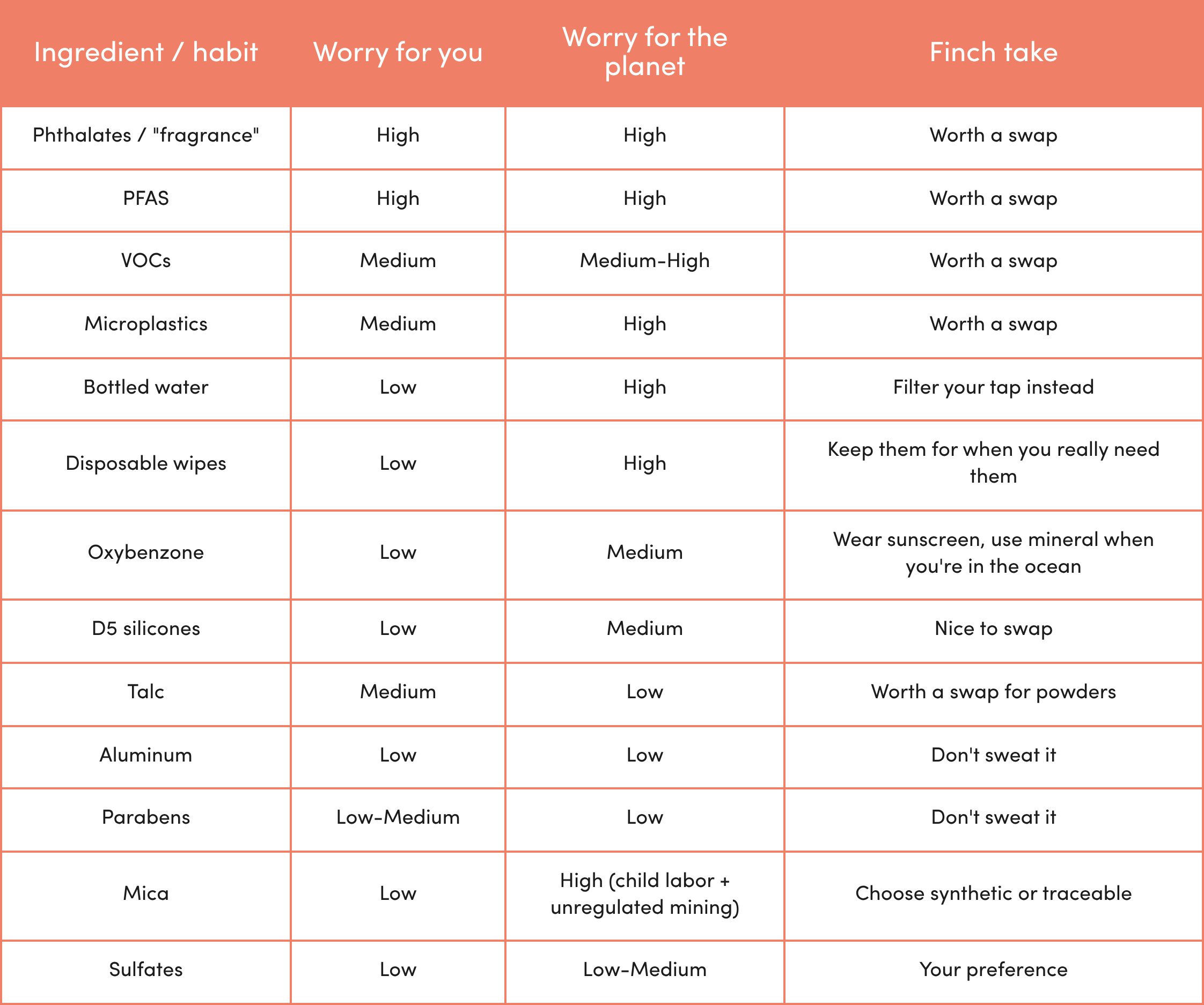
Here's where 13 of the most-asked-about ingredients and habits land.
Group 1: Both dials are up (the win-win swaps)
These are the best places to spend your energy, because one change helps you and the planet.
Phthalates (and the word "fragrance")
- What people say: "Phthalates are hormone disruptors hiding in everything."
- What we know: This one is mostly right. Phthalates are chemicals that make plastic soft (think vinyl shower curtains and PVC) and help scents last longer. They're linked to hormone disruption, especially during pregnancy and early childhood. The CDC finds them in most Americans' urine. In personal care products they usually hide under one word: “fragrance” which brands can use to keep the full ingredient list a trade secret. On the planet side, PVC is one of the hardest plastics to recycle and one of the most toxic to make.
- Worry for you: High · Worry for the planet: High
- Finch take: Worth a swap. Go fragrance-free (or look for "phthalate-free fragrance"), and skip vinyl when you can.
PFAS ("forever chemicals")
- What people say: "Nonstick pans are poisoning us."
- What we know: PFAS are a family of thousands of chemicals that resist water, grease, and stains. That's useful in a pan or a raincoat, and it's also why they essentially never break down. Some are linked to certain cancers, thyroid disease, and lower vaccine response. They're now in the drinking water of millions of Americans, and the EPA set the first national limits for some of them in 2024. Your old pan is a small part of the story. Factories, firefighting foam, and waterproof gear are the big ones.
- Worry for you: High · Worry for the planet: High
- Finch take: Worth a swap when things wear out. Choose cast iron, stainless, or ceramic. Skip "stain-resistant" treatments. And if you're worried about your tap water, a filter certified for PFAS is a better buy than bottled water (more on that below).
VOCs (volatile organic compounds)
- What people say: "Candles and air fresheners are toxic."
- What we know: VOCs are gases released by paints, cleaners, air fresheners, scented products, and gas stoves. Indoor air often has more of them than outdoor air. Some, like benzene and formaldehyde, are known to be harmful. Here's the surprising part: a 2018 study found that in cities, everyday products like perfume, lotion, and cleaners now add as much to air pollution as cars do.
- Worry for you: Medium · Worry for the planet: Medium-High
- Finch take: Worth a swap. Open a window, choose fragrance-free cleaners, and look for low-VOC paint. Swap aerosol air fresheners for... fresh air.
Microplastics
- What people say: "There's plastic in our brains."
- What we know: There's plastic basically everywhere we've looked, including blood, placentas, and arteries. A 2024 study found that people with microplastics in their artery plaque had a higher risk of heart attack and stroke. The research is still early, and it can't yet prove plastic is the cause. On the planet side, there's no debate: plastic is everywhere and it's not going away.
- Worry for you: Medium (and rising as we learn more) · Worry for the planet: High
- Finch take: Worth a swap. The biggest one: don't heat food in plastic. Use glass or ceramic in the microwave and dishwasher.
(BPA belongs here too, but I’m writing a whole issue on it next week, and why "BPA-free" doesn't always mean what you think. Look out for that soon.)
A hopeful one: triclosan. Remember "antibacterial" soap? Triclosan was in tons of it, and it was linked to hormone effects and antibiotic resistance. It was also showing up in waterways. In 2016, the FDA banned it from consumer hand soaps after companies couldn't show it worked better than regular soap and water. It's proof that both dials can come down together.
Group 2: The planet dial is higher (the "health halo" group)
This is where health and sustainability really pull against each other. These things feel healthy, or are fine for you, but the planet pays.
Bottled water
- What people say: "Bottled water is safer than tap."
- What we know: For most people in the U.S., tap water is regulated more strictly and tested more often than bottled water. And the bottle has its own problem: a 2024 study found about 240,000 tiny plastic particles in an average liter of bottled water. So the thing people buy to avoid contaminants delivers a new one, plus a plastic bottle.
- Worry for you: Low (and not lower than tap) · Worry for the planet: High
- Finch take: Filter your tap if you're concerned, and carry a refillable bottle.
Disposable wipes
- What people say: "Wipes are more hygienic."
- What we know: Most wipes are made with plastic fibers, even the ones that feel like cloth. "Flushable" wipes usually don't break down like toilet paper. They help create the giant sewer clogs cities call "fatbergs." Many also contain fragrance and preservatives that irritate skin.
- Worry for you: Low · Worry for the planet: High
- Finch take: Keep them for when you really need them (diaper changes, travel). For counters, faces, and adult butts, a washcloth or bidet works just as well.
Oxybenzone (in chemical sunscreen)
- What people say: "Chemical sunscreen is toxic, and it's killing coral reefs."
- What we know: Two different claims here. For you: a 2019 FDA study found oxybenzone gets absorbed into the bloodstream. That means more research is needed, not that it's harmful. Skipping sunscreen is a much bigger, proven risk. For the planet: lab studies show oxybenzone can harm coral, which is why Hawaii banned it in 2021. In the real world, climate change and warming oceans are by far the bigger threat to reefs. Because there are so many worthwhile alternatives like mineral sunscreens or sunscreens made without oxybenzone, it’s an easy swap.
- Worry for you: Medium · Worry for the planet: High
- Finch take: Wear sunscreen, period. Get ones without Oxybenzone (and non-aerosol, while we’re making swaps).
D5 (cyclopentasiloxane)
- What people say: "Silicones are bad for your hair and skin."
- What we know: D5 is the silicone that gives conditioner and primer that silky, smooth feel. It isn't considered a real health risk at the levels in cosmetics. The problem is what happens after you rinse it off: it builds up in waterways and in aquatic animals. The EU has restricted it in rinse-off products since 2020 and is now expanding those limits.
- Worry for you: Low · Worry for the planet: Medium
- Finch take: Nice to swap, especially in things you rinse down the drain.
Mica
- What people say: "Mica is a natural mineral, so it's clean."
- What we know: Mica is the mineral that makes eyeshadow, highlighter, and "glowy" lotions shimmer (it's also in car paint and electronics). For you, it's considered safe in cosmetics. The one real health risk is breathing in the dust, which is mostly a danger for the people mining it. The problem is where it comes from. A large share of the world's mica is mined in India's Jharkhand and Bihar states and in Madagascar, often from small, unregulated pits. Investigations have estimated that tens of thousands of children work in India's mica mines, and many of those mines are illegal, dug into forest land without permits or safety rules. This is why the second dial isn't only about the planet. It's about the people at the start of the supply chain, too.
- Worry for you: Low · Worry for the planet (and people): High
- Finch take: Worth a swap, or at least worth asking. Look for synthetic mica (listed as "synthetic fluorphlogopite") or brands that can tell you where their mica comes from, like members of the Responsible Mica Initiative. "Natural" is the problem here, not the solution.
Group 3: The "you" dial is higher
Talc
- What people say: "Baby powder causes cancer."
- What we know: Talc itself isn't the main worry. The problem is that talc is mined, and talc deposits can sit next to asbestos, a known cause of cancer. Contaminated talc is behind thousands of lawsuits, and Johnson & Johnson stopped selling talc baby powder in the U.S. in 2020. On the planet side, it's a mined mineral, but it's not a major environmental problem.
- Worry for you: Medium · Worry for the planet: Low
- Finch take: Worth a swap, especially for anything you might inhale (loose powders, dry shampoo). Look for cornstarch- or arrowroot-based versions.
Group 4: You can (mostly) relax
These are the ingredients that get the most fear online, and where the evidence is the most reassuring. It's worth knowing, because "free-from" products often cost more, and that energy is better spent on Group 1.
Aluminum (in antiperspirant)
- What people say: "Aluminum in antiperspirant causes breast cancer and Alzheimer’s”
- What we know: Both fears have been studied a lot. The American Cancer Society and the National Cancer Institute say there's no convincing evidence linking antiperspirant to breast cancer. The Alzheimer's link came from older research that later studies didn't support. One real caveat: people with advanced kidney disease are told to avoid aluminum. (Also worth knowing: "deodorant" covers up odor and doesn't contain aluminum. "Antiperspirant" stops sweat, and that's the one with aluminum.) Aluminum can lead to skin irritation, so if you’re especially sensitive, that would be a reason to switch.
- Worry for you: Low · Worry for the planet: Low
- Finch take: Use whatever works for you. If you're switching, switch for packaging. A refillable stick or a cardboard tube is the real sustainability win here.
Parabens
- What people say: "Parabens cause cancer."
- What we know: Parabens are preservatives, which means they stop mold and bacteria from growing in your lotion. They can act a tiny bit like estrogen. That's much, much weaker than the body's own estrogen, but it's why they've been studied so much. A 2004 study that found parabens in breast tumors got a lot of attention, but it didn't show that parabens caused the tumors. The EU banned five less-studied parabens in 2014 and still allows the common ones at low levels. Here's the twist: some "paraben-free" products use replacement preservatives that cause more skin allergies, not fewer.
- Worry for you: Low-Medium · Worry for the planet: Low
- Finch take: Don't sweat it. If you're pregnant and want to be extra careful, avoiding them is a reasonable personal choice. Just know that "paraben-free" isn't automatically better.
Sulfates (SLS/SLES)
- What people say: "Sulfates are toxic."
- What we know: Sulfates are what make shampoo and soap foam. They can dry out or irritate sensitive skin and scalps, which is a real comfort issue but not a toxicity issue. They break down easily in the environment. The bigger planet question is where they come from. Many are made from palm oil, so look for responsibly sourced palm (or coconut-based versions).
- Worry for you: Low · Worry for the planet: Low-Medium (depends on the palm oil)
- Finch take: Go sulfate-free if your skin or hair likes it better. It's not a safety issue.
The cheat sheet
If you only change three things
- Go fragrance-free in the products you use most (laundry detergent, lotion, cleaner). That one change cuts phthalates, VOCs, and skin irritants all at once.
- Stop heating food in plastic. Use glass in the microwave and dishwasher.
- Replace nonstick with cast iron or stainless when your pans wear out. Don't throw out a working pan just to replace it.
The bigger point: "natural" doesn't mean safe, and "chemical" doesn't mean scary. Everything is a chemical, including water. The questions that matter are how much, how often, and where it ends up after you're done with it.
Subscribe now to continue reading.
(16% discount)
• Access to unlimited articles
• Sustainable product guides & recommendations
• Weekly newsletters
Already a member? Log in.