


Lord Of The Cords


This Week We’re Untangling:
- Why the cords in your junk drawer is the least of your problems
- How Colorado became the Right to Repair State (Apple, we see you)
- Exactly what to do with your old tech
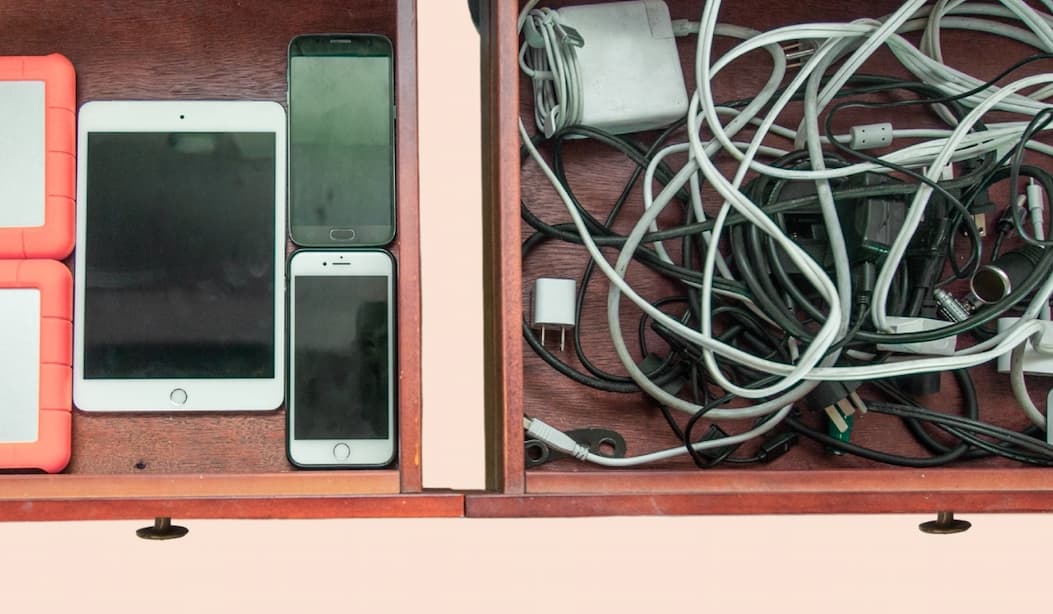
Every house has that drawer. Mine happens to have many, but that’s a story for my therapist. One of these drawers is a singular snake pit of cords. I honestly think there’s one for an iPod generation 3 and baby monitor we’ve long retired. Somewhere in that tangle, I was sure, was the charger for my Kindle, a trusty 2014-ish model that has been dead for longer than my kids have been alive. I’ve looked for that charger more times than I’d like to admit, but usually end up using my mom’s charger whenever I see her and hoping the charge lasts until our next reunion.
In researching this article, I did what I should have done years ago and actually looked it up. Kindles from that era charge with a plain micro-USB cable, the same cord that came with roughly every Android phone, bluetooth speaker and electric toothbrush of the 2010s. Embarrassingly, I’ve probably owned the Kindle charger the entire time. Possibly 9 of them? So let’s dig into what’s actually in The Drawer, why we hold onto it, and where it’s supposed to go.
TL;DR: The cords are actually the easiest part.
Cords and cables are mostly copper wrapped in plastic, and copper is one of the most recyclable materials out there. They’re about as low-drama as Keanu Reeves. Most cities’ electronics recycling program lists wires and cables among its accepted items, so bundle yours with a twist tie and send them off with your next drop-off.
The more interesting question is why we keep all of it. When researchers surveyed about 8,800 households across six European countries, 46% said the main reason they hang onto small electronics is that they might use them someday. (Guilty: I’ve been “someday-ing that 2003 iPod and read about 100 physical books since my Kindle died). The same research, from WEEE Forum and UNITAR, estimated that about 5.3 billion phones dropped out of use in 2022, and most would disappear into drawer or head to landfills and incinerators. That many phones would reach about ⅛ of the way to the moon if we’re in the mood for meaningless comparisons. 4 years later, we’re at least 1/7 to the moon.
This matters because of when a device does most of its damage. For a smartphone, the bulk of the climate footprint happens before you ever unbox it. Apple’s own product environmental reports show production (materials, manufacturing, and the electricity to make it all) accounting for about ¾ of the iPhone 17’s lifetime emissions, and more than 80% for older models like the iPhone 6 Plus. Charging it every night for years is small by comparison, so the most sustainable thing you can do with a working device is to keep using it. After that, we want to get it into someone else’s hands, and recycling is the backup plan.
When a device is truly done, it’s a tiny treasure chest. Phone’s contain gold, silver, copper, palladium and rare earth elements., which is why recovering them is called “urban mining.”
Apple's disassembly robot, Daisy, takes apart 200 iPhones an hour to get at those materials. The problem is scale. The Global E-waste Monitor 2024 found the world generated 62 million tonnes of e-waste in 2022, and only 22.3% was formally collected and recycled. By 2030, it projects 82 million tonnes, with the documented recycling rate slipping to around 20%. We're producing this stuff faster than we're dealing with it.
Then there's the part of The Drawer that can literally catch fire. Lithium-ion batteries, the kind in your old phone, Kindle, earbuds, and the vape someone left at your house, can ignite when they get crushed in a garbage truck or sorting facility. An EPA analysis found 245 fires caused or likely caused by these batteries at 64 waste facilities between 2013 and 2020, most commonly from phones, tablets, and laptops. The agency notes that's an undercount, since many fires never make the news. Anything with a battery stays out of both your trash can and your curbside recycling bin, and the EPA recommends bagging loose lithium-ion batteries individually and taping the terminals before drop-off.
One more fun fact for my fellow Coloradans: throwing electronics in the trash has been illegal for residents here since July 2013. So technically, the drawer is the law-abiding option. Barely.
The Right To Repair State
If you've ever been quoted a price to fix a cracked screen and thought, "I could almost buy a new phone for that," you've felt planned obsolescence in your wallet. Colorado is trying to do something about it.
On January 1, Colorado's Consumer Right to Repair Digital Electronic Equipment law (HB24-1121) took effect, and repair advocates have called it one of the strongest in the world. It requires manufacturers like Apple and Samsung to give owners and independent repair shops access to parts, tools, software, and repair documentation for devices sold or first used in Colorado after July 1, 2021. Software tools have to be provided free, and breaking the law counts as a deceptive trade practice.
The most interesting part is its ban on parts pairing, the practice of digitally tying a component to one specific device, so a replacement screen or battery (sometimes even a genuine one) triggers warnings or loses features. For equipment sold in Colorado after January 1, 2026, manufacturers can't use pairing to block replacement parts, degrade performance, or flash misleading alerts about "unknown" components. Apple lobbied against parts-pairing bans in both Oregon and Colorado, and the bill's sponsor has said its rollout was delayed partly so Apple could adjust its phone design to comply.
I'll be honest, Apple is a complicated villain. This is the company that agreed to pay up to $500 million in a 2020 class-action settlement over slowing down older iPhones with aging batteries. It's also the company whose recycling robot can now disassemble 36 iPhone models, and which says the batteries it designs now use 100% recycled cobalt. Both things are true. Apple has been excellent at recovering materials at the end of a device's life and historically much less enthusiastic about letting you extend that life yourself. Laws like Colorado's are pushing those two instincts closer together, and Apple has since made batteries easier to swap.
Apple Isn’t Alone
In April, Amazon emailed owners of Kindles released in 2012 or earlier that their devices would lose Kindle Store access on May 20. Thirteen models were affected. Books already downloaded still work, but reset or deregister one of those devices now and it can't be registered again. Amazon pointed out that these models had been supported for 14 to 18 years, which is a genuinely long run for a gadget. Still, a device that turns on and works fine got functionally retired by a software decision, and Amazon paired the news with a 20% discount on a new Kindle plus a $20 ebook credit. (My 2014 Kindle survived the cut. For now.)
Are You Ready To Face The Drawer?
- Sort it into piles
Works. Broken but maybe fixable. Truly done. Cords get their own pile, and before you do anything else, test whether any of them charge something you forgot about (hi).
- Protect your data
- Everything: Back up what you want to keep, then pull out SIM cards and memory cards.
- iPhone or iPad: Sign out of your Apple Account and turn off Find My first, otherwise Activation Lock makes the device useless to its next owner. Then go to Settings > General > Transfer or Reset iPhone > Erase All Content and Settings.
- Android: Remove your Google account before resetting (Factory Reset Protection will otherwise lock out the next person), then do a factory reset.
- Laptops: Sign out of iCloud or your Microsoft account. On a newer Mac, use Erase All Content and Settings; on Windows, go to Settings > System > Recovery > Reset this PC > Remove everything.
- Kindles: Deregister (Settings > Your Account) and reset before passing one on. The big exception: if it's from 2012 or earlier, resetting now permanently locks it out of Amazon, so only reset if you're recycling it.
- Won't turn on? Choose a recycler that offers certified data destruction rather than trying to wipe it yourself.
3. Find it a home
If it works, sell it or trade it in (Back market, Apple Trade In, or your carrier), or donate it. In 11 cities, PCs for People refurbishes computers for low-income households. Your local groups, libraries, and Buy Nothing groups are worth asking, too.
If it’s fixable, start with iFixit’s free repair guides, or take it to an independent repair shop (this seems…obvious. But spelling it out sometimes motivates, no?)
If it’s truly done, check your city’s E-Cycle Coupon or recycle options. If your city isn’t the right answer, check whether the manufacturer or a retailer like BestBuy or Staples takes it back. For batteries, use Call2Rexycle’s locator for batteries (or my guy Ridwell).
Back Market:
If The Drawer taught me anything, it's that the greenest phone is one that already exists. Back Market is a marketplace for professionally refurbished phones, laptops, tablets, and more. It was founded in Paris in 2014 and is a certified B Corp. Devices come with a one-year warranty and a 30-day return window, and prices run up to 70% below new.
Back Market says a refurbished smartphone generates about 92% less carbon than a new one. That's the company's own number, but the GSMA, the global mobile operators' group, lands in a similar place with an estimate of about 87%. Back Market also runs a trade-in program, so it works in both directions for The Drawer.
And their marketing is delightfully petty. In 2022, they used AirDrop to beam "switch to refurbished" messages onto the display devices inside Apple Stores in Paris, Berlin, and London. I'd pay to see the Genius Bar's faces.
One caveat: because it's a marketplace, you're buying from vetted third-party refurbishers, and condition grades vary. Check battery condition before you buy, since a tired battery is the most common reason a refurbished phone feels old.
Honorable mention: iFixit. Free repair guides for thousands of devices, affordable toolkits, and some of the loudest advocates behind laws like Colorado's.
The E-Waste Graveyard: Colorado PIRG's 2026 list gives dead devices actual tombstones, complete with cause of death (Google Nest thermostats, Windows 10, and yes, 13 Kindle models), and estimates more than 1.7 billion pounds of potential e-waste.
Here’s what else is happening:
- The EU's right to repair kicked in July 31, giving Europeans more rights to get devices repaired even after the warranty expires. Some German environmental groups are already criticizing it for weak enforcement.
- International E-Waste Day is October 14. Consider this your official excuse to empty The Drawer.
- Pour one out for Lightning cables. The EU's USB-C requirement, which took effect at the end of 2024, pushed Apple onto USB-C. Great for future e-waste, less great for the millions of Lightning cords now living in drawers like mine.
- Coming in 2027: EU battery rules that require phone batteries to be removable and replaceable by users.
Subscribe now to continue reading.
(16% discount)
• Access to unlimited articles
• Sustainable product guides & recommendations
• Weekly newsletters
Already a member? Log in.